News
A call for help from the Saguanay-Lac-Saint-Jean county
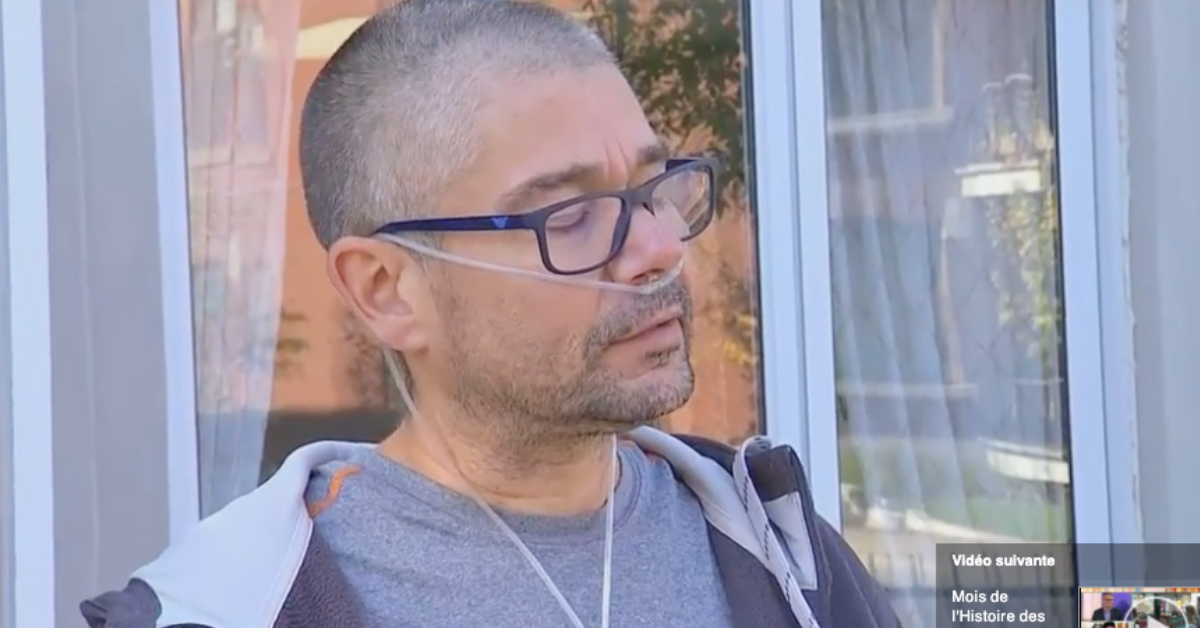
95.7 KYK FM featured an interview with Mr. Mario Tremblay, a resident of the House, to shed light on the situation and the very real challenges faced by Maison des greffés Lina Cyr.
We invite you to read the article or listen to this moving interview, which clearly illustrates the mission and importance of Maison des greffés Lina Cyr for transplant patients living in remote regions.
Thanks to Mr. Tremblay’s initiative, a Mario Jean show — with 100% of the proceeds donated to the House — will take place on September 17:
https://m.reseau.ovation.ca/FR/Search/EventInfo…
Please share the interview with your loved ones so the message can spread, and so life can go on.
https://www.957kyk.com/audio/779293/cri-du-coeur-pour-sauver-la-maison-des-greffes-lina-cyr

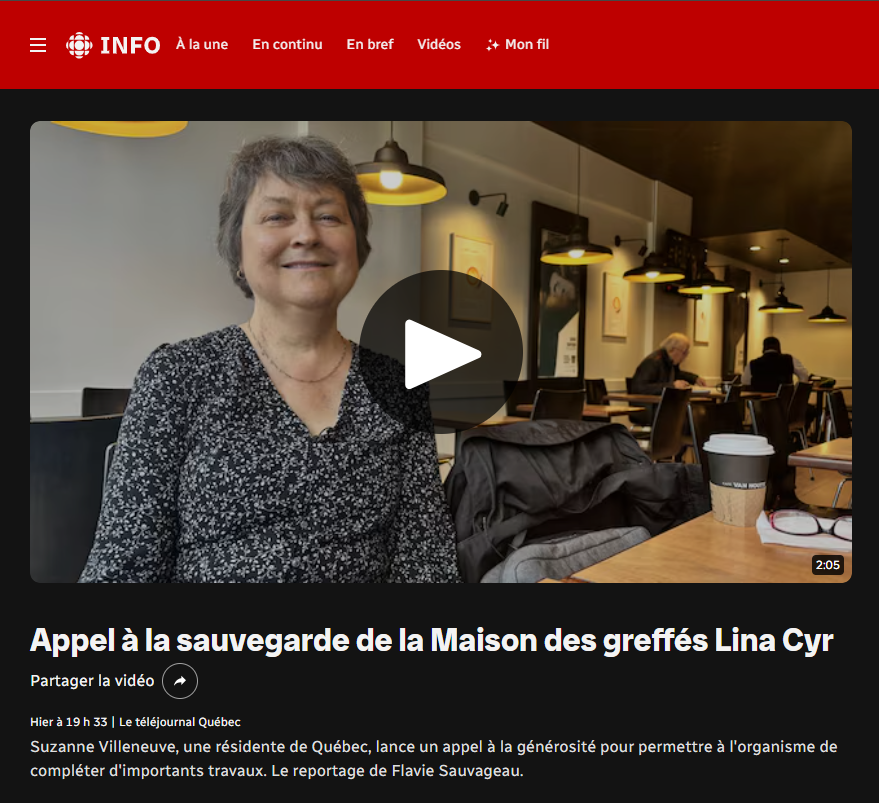
Radio-Canada amplifies Ms. Suzanne Villeneuve’s heartfelt plea.
Yesterday, Monday, May 25, 2026, an article was published regarding the emergency situation currently facing the Maison des greffés Lina Cyr, including the testimony of a resident of the Capitale-Nationale region, Ms. Suzanne Villeneuve. Reiterating the financial shortfall and the urgent nature of the situation, the article also highlights the services offered by the Maison and their essential role in ensuring the health and safety of transplant patients and their loved ones.
A news report accompanying the article was also broadcast on May 25, 2026.
You can view the article and the report at the following link (in French) : https://ici.radio-canada.ca/nouvelle/2256612/femme-quebec-sauvegarde-maison-greffes
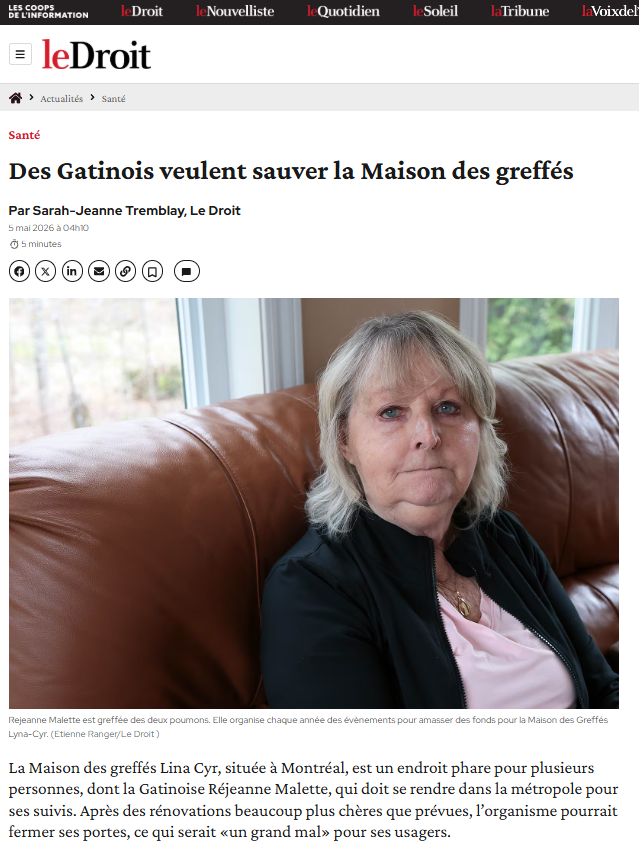
Mrs Malette in the ” Le Droit” newspaper
Notre ambassadrice de la région de l’Outaouais, Mme Réjeanne Malette a récemment fait l’objet d’une entrevue publiée dans le journal Le Droit le 5 mai 2026 dernier.
Nous tenons à saluer l’implication de Mme Malette dans le succès de la pérennité de la Maison des greffés Lina Cyr depuis plusieurs années déjà.
Voici le lien pour consulter l’article : https://www.ledroit.com/actualites/sante/2026/05/05/des-gatinois-veulent-sauver-la-maison-des-greffes-V7HXLXJYYFGGPMHZ7567BDQOFU/
(Un abonnement gratuit est disponible pour accéder au contenu de l’article en entier.)
12 hours hockey challenge 2026
Saturday marked the Sûreté du Québec Police Service’s 12-hour hockey challenge!
Thanks to your participation and generosity, $8,415 was raised for the Lina Cyr Transplant House to support its mission of helping transplant recipients or those waiting, as well as their loved ones.
A huge thank-you to the entire hockey and police team from the Sûreté du Québec, as well as Genevière Racine, Joël Desruisseaux, and Francis Goupil for their support of our mission through hosting this community event—especially during playoff season!
Thank you also to the mayor of Cowansville, Ms. Sylvie Beauregard, pictured here in both photos offering a check to Ms. Micheline Cyr Asselin, Executive Director of the Lina Cyr Transplant House.
Thank you to all donors, sponsors, and volunteers—everyone who contributed, near or far, to make this event a success! Every donation has a direct impact on maintaining our services.
You can continue supporting the Lina Cyr Transplant House via the following link:
With heartfelt thanks 







Radio-Canada Abitibi meets one of our residents
Alexandre Perreault, a resident of the Maison des greffés, was invited by Radio-Canada Abitibi to share a moving testimonial in support of our organization as part of our emergency fundraising campaign. The Rouyn-Noranda native understands the importance of our mission and chose to promote it so that life can go on…
Visit the following link to read the article published on April 24 on the Radio-Canada website: https://ici.radio-canada.ca/nouvelle/2248555/greffe-maison-lyna-cyr-maison

Open Letter for the Survival of the Maison des greffés Lina Cyr
A Vital Link Under Threat
Take a moment to imagine this.
You live in a remote region. You’ve been waiting for a transplant for months, sometimes years. Then one day, the call comes — the one that can change everything.
But before you even enter the operating room, another challenge arises: getting to Montreal. Not for a night or two. For weeks. Sometimes months.
During National Organ and Tissue Donation Awareness Week, we rightly highlight the importance of donation — that extraordinary act that saves lives. But we talk less about everything that makes that act possible. Everything required for a transplant to truly succeed.
Because behind every successful transplant is a complex, fragile, deeply human chain of care. And like any chain, it is only as strong as its weakest link.
Today, one of those links is under threat: the Maison des greffés Lina Cyr.
Each year, more than 2,500 patients from across Quebec must travel to Montreal for a transplant. Before surgery, they need to stay close to the hospital for one to two weeks. Afterward, follow-up care is frequent — sometimes several times a week — over a period of one to three months.
For these often exhausted and immunocompromised individuals, having a place to stay near the hospital is not a minor detail. It is essential to the success of their recovery. It also allows them to leave the hospital sooner and regain some breathing room outside a strictly medical setting.
Let’s be clear: the Maison des greffés is not just a roof.
It is a lifeline.
At $35 per night, it provides accessible, humane accommodation where patients can rest between appointments, catch their breath, and regain a sense of normalcy. It helps prevent unnecessary hospitalizations or unsuitable hotel stays, while generating significant savings for the healthcare system — up to $8,500 per day, per patient.
Above all, it allows transplant recipients to go through this ordeal with dignity.
And yet today, the long-term viability of this essential resource is under threat.
The Maison is housed in a heritage building that now requires major renovations. Unexpected structural constraints have driven costs up to $2.8 million. Despite rigorous management. Despite initial government support — which deserves recognition. The reality is simple: the situation now exceeds the organization’s capacity.
Without a rapid solution, its future is at serious risk.
The consequences would be immediate: patients forced to extend hospital stays, others left to juggle temporary, costly, and sometimes unworkable alternatives. Added strain on an already overburdened healthcare system. And ultimately, compromised care pathways.
In recent months, Quebec has become more aware of how delicate the transplant system truly is. Thanks to strong mobilization, some gains have been protected. But the threat we face today is quieter — and just as concerning.
Organ donation is not limited to a medical act. It relies on an entire ecosystem: healthcare teams, loved ones, and community-based resources that support patients long after surgery. The Maison des greffés is one of these quiet pillars.
Protecting it means ensuring that every donation can truly become a life saved.
At a time when we celebrate the solidarity and generosity behind organ donation, it is urgent to safeguard the resources that make this gift possible.
Because a chain only holds if every link holds too.
Martine Bouchard, President and Chief Executive Officer, Transplant Québec
Richard Tremblay, President, Canadian Organ Donation Association
Dr. Michel Lallier, Pediatric Surgeon, Sainte-Justine Hospital; Living Donor Kidney Transplant Surgeon, CHUM
Dr. Charles Poirier, Medical Director, Lung Transplant Program, CHUM
Julie Lemire, Liver Transplant Recipient (Abitibi–Témiscamingue)
Léo Basile, Awaiting a Lung Transplant (Côte-Nord)
Mélanie Mollen, Caregiver to a Person Awaiting a Lung Transplant (Côte-Nord)
Daniel St-Onge, Kidney Transplant Recipient (Mauricie)
Doris St-Onge, Caregiver to a Kidney Transplant Recipient (Mauricie)
Réjeanne Mallette, Lung Transplant Recipient (Outaouais)
Alexandre Perreault, Kidney Transplant Recipient (Abitibi–Témiscamingue)
Dale Wormsley, Liver Transplant Recipient (Abitibi–Témiscamingue)
Patrice Dionne, Heart and Liver Transplant Recipient (Québec)
The letter was published on Tuesday April 21 2026 by the Journal de Montréal and on their website: https://www.journaldemontreal.com/2026/04/21/la-maison-des-greffes-un-maillon-vital-menace
A call for help
An article was published by the Journal de Montréal on December 18th of 2025 to highlight an interview with Mme Micheline Cyr Asselin concerning our emergency fundraising campain. You wan read the full article by following the link below:
https://www.journaldequebec.com/2025/12/25/ca-me-creve-le-coeur–la-maison-des-greffes-menacee-de-fermeture-en-raison-de-travaux